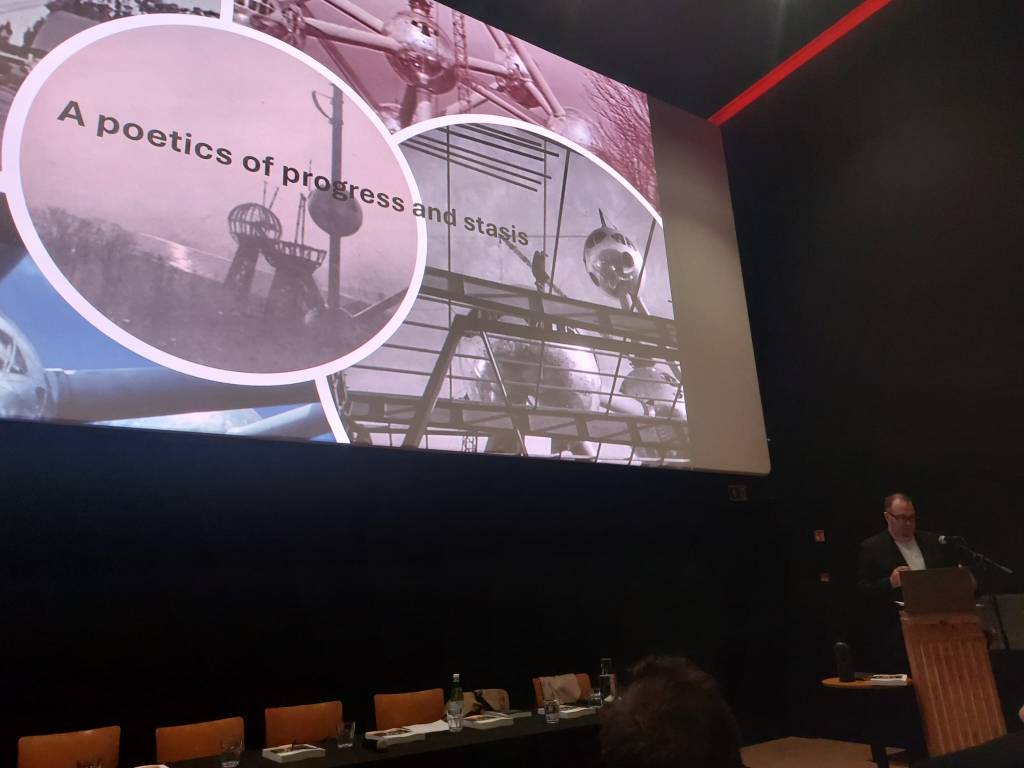
Earlier this week, on 31 August, I successfully defended my PhD dissertation at De Cinema in Antwerp. My research, titled Poetics of Belgian Post-War Documentary Film through the Prism of Expo 58, explores the friction between Belgium’s polished self-image and the realities of its post-war documentary cinema.
The 1958 World’s Fair in Brussels was designed to showcase the post-war reconstruction and modernisation of Belgium. Through colonial, tourism and industrial films the country promoted itself as a modern welfare state with a benevolent colonial mission, a thriving industry and a rich cultural heritage that captivated tourists from all over the world.
While Expo 58 portrayed Belgium as a cultural and political crossroads of international humanism, little attention was paid to the darker sides of this widely held narrative. My research demonstrates that while Belgium fully embraced film to project a modern image, it largely eschewed the self-reflection, experimentation and critical perspectives that came with cinematic modernism.
In 1970, after years of difficulties to finish their film, Le chantier des gosses, shot in the poor neighborhoods of Brussels in the run-up to Expo 58, Marcelle Dumont – dialogue writer and wife of Jean Harlez – remembered: “In 1958, Belgium was courting Expo visitors, so it wasn’t a good idea to show the other side of the coin.”
Marcel Broodthaers, at the time a young journalist and photographer and not yet a world-renowned artist, had a similar observation in the run-up to the Fair. As part of his embedded report written at the construction site of Expo 58, he wondered: “Can you make cinema out of real life?”
Sparked by these observations, I examined how Belgian documentary filmmakers represented Belgium’s modernisation in the context of the 1958 Fair. Combining close analysis with contextual research, this research grew into an exploration of the Belgian post-war film landscape. I investigated institutions that made filmmaking possible, or impossible, studied filmmakers and their work to see which options were available to them, and analysed the discourse of the film sector – including festivals – as well as journalists. To sum it up, my dissertation offers a historical-poetical analysis of Belgian post-war documentary cinema, demonstrating its complex and paradoxical nature within a poetics of progress and stasis.
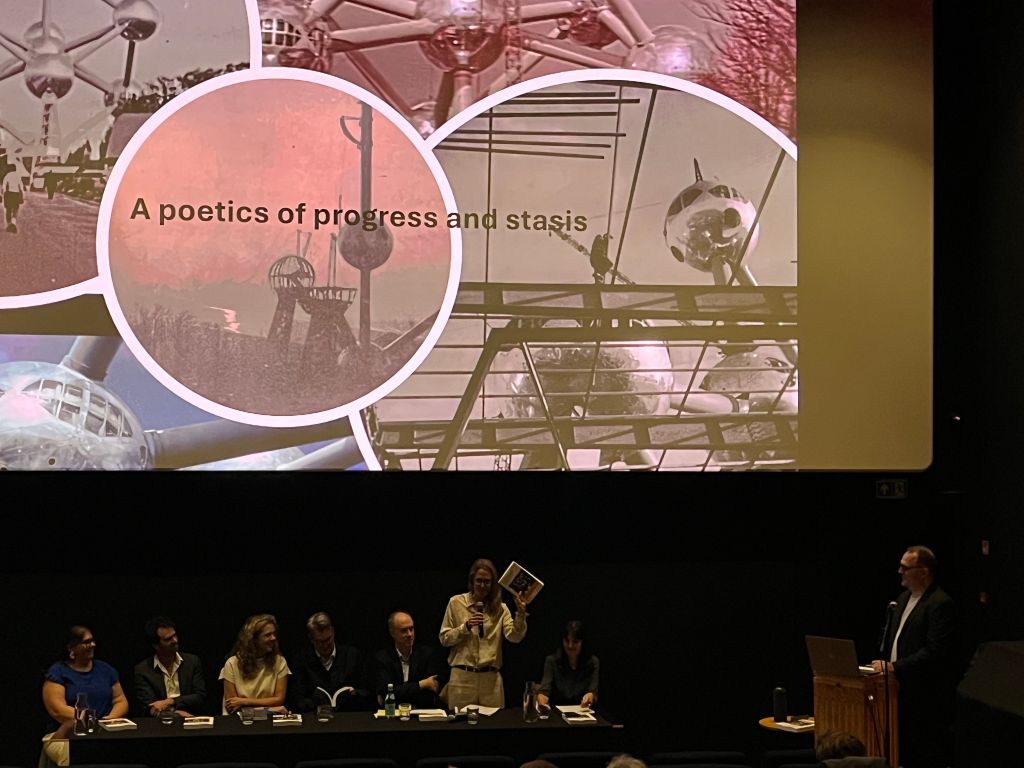
My thesis is a joint PhD between the University of Antwerp, where I obtained the degree of Doctor in Theater Studies and Intermediality, and the University of Namur, where I obtained the degree of Doctor in History, Art History and Archeology. (With a dissertation on film, mind you.)
The doctoral jury was chaired by Diana Arbaiza (University of Antwerp) and consisted of Anne Roekens (University of Namur), Leen Engelen (KU Leuven/LUCA School of Arts), Steven Jacobs (University of Antwerp), and Tom Rice (University of St Andrews), as well as my supervisors Bénédicte Rochet (University of Namur) and Gertjan Willems (University of Antwerp).
I’d like to thank them all for critically engaging with my research. I also thank the many people who have crossed my path over the years, contributing each in their own way to the words I tried to find for film and its histories.
I look forward to future encounters.

